

(Hornazo from La Favorita, in Salamanca)
Today, the Monday after Easter Monday, the city of Salamanca and some towns in the province celebrate the now-famous Lunes de Aguas (Water Monday), a popular festival that symbolizes the end of Holy Week penance, a day on which the Hornazo (a savory pie) takes center stage. And, of course, in Guijuelo, the town that houses our sausage and Iberian pork factory, it is also a day of celebration.
Today, it's one of the most traditional festivals in Salamanca, and one that locals are proud of for its originality. Families, groups of friends, and gangs gather for a picnic or to spend the day in the countryside, enjoying games and music, but above all, a very distinctive culinary display, in which, of course, the Hornazo (a savory pie) reigns supreme.
What is the Hornazo of Lunes de Aguas?
First, we will refer to the official definition of the Hornazo de Salamanca Guarantee Mark: “It could be said that it is like a wheat flour empanada, filled with typical products from Salamanca (marinated pork loin, ham and chorizo), golden in color and decorated with a rhomboidal mesh of the same dough.”
From there… like in a pharmacy… it is fair to acknowledge that we can find many other different recipes or with small variations, depending on the family, the town, the bakery or the cook who prepares it.
The dough can vary, being more or less dense, made from bread or puff pastry. Inside, some add hard-boiled egg, others don't… but what will never be missing from the exquisite filling of a Hornazo are the wonderful products derived from the Iberian pig slaughter, so richly produced in our region. In this case, we're referring to fresh or cured pork loin , ham or shoulder ham, and Iberian pork chorizo .
In short, Lunes de Aguas is a very Salamancan festival. It's hard to find a house today that won't smell of Hornazo, Iberian chorizo… Wow, it's so ours!
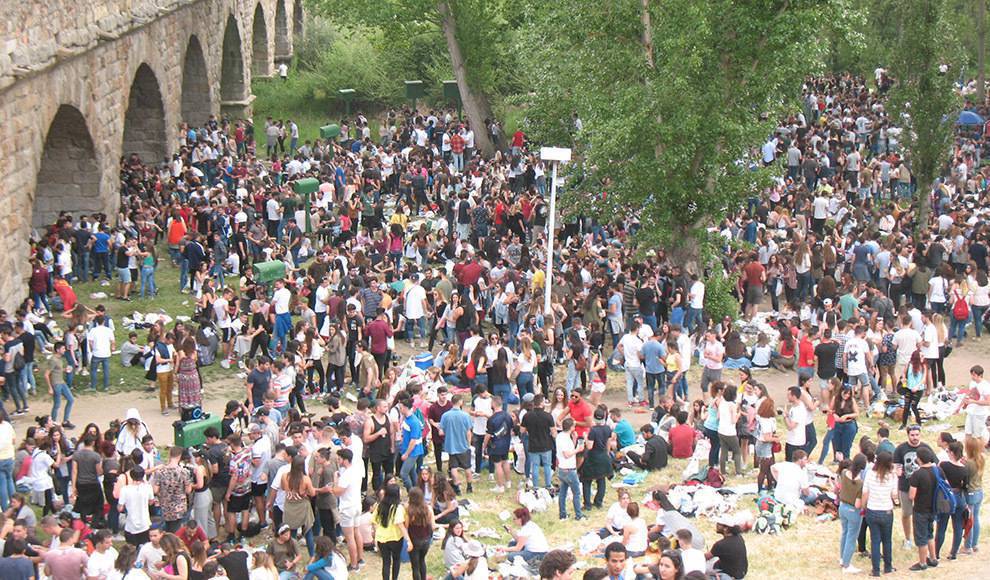
(Photo: tribunasalamanca.com)
How did the tradition of Lunes de Aguas (Water Monday) originate?
The celebration of Lunes de Aguas (Water Monday) dates back to the 16th century, during the reign of a very young Philip II. The monarch visited Salamanca in 1543 to marry Princess Maria Manuela of Portugal. He was "astonished at how this sober and stately capital of the Meseta Central combined within its borders the temple of knowledge, the beacon of European Christianity, dogma and the word, and at the same time, leisure and entertainment without limits or restraint." Later, being very "upright and religious," the king decreed that during Lent and Holy Week, meat could not be consumed as a symbol of penance, "in every sense."
It was then that the city's prostitutes were forced to move to the other side of the river to avoid tempting the citizens. And after their period of penance, on the first Monday after Easter Monday, these women were brought back to the city by boat, while a festival was held on the riverbank to welcome them. This celebration is what has endured to this day as Water Monday.


